City Hall: 108 North Idaho Street
Open Hours: Monday – Friday | 8 am – 5 pm
Location – 42° 3.855′ N, 94° 43.999′ W.
Address – Intersection of Lincoln Highway (U.S. 30) and Sherwood Avenue (Arizona Street) – Glidden Northland Park
Weight – 100 ton
Height – 11 feet tall
Miles transported – 23 miles
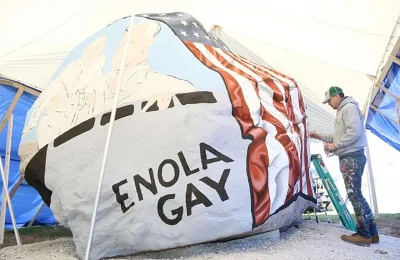
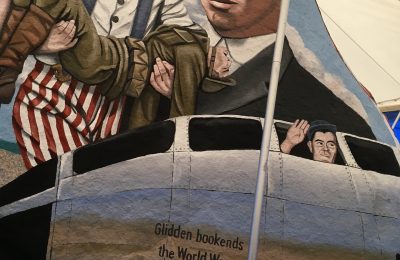
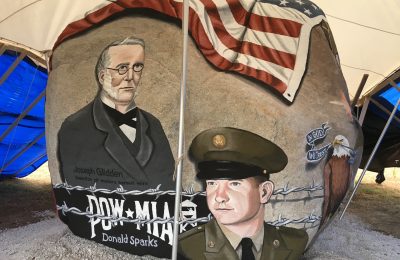
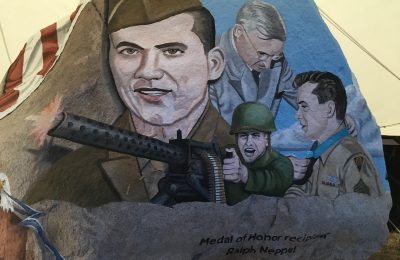
Yes, Liberty Rock. Carroll County already has a Freedom Rock located in Manning, but on the west side of Glidden, Iowa is a Liberty Rock, also created by Bubba Sorenson. The rock features patriotic and local historical imagery, including Merle Hay (the first Iowan killed in WWI), the “Enola Gay” plane, WWII veteran Ralph Neppel, and Vietnam POW/MIA Donald Sparks.
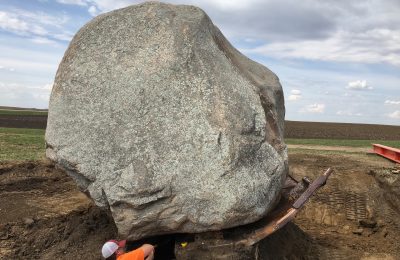
A Bayard landmark has now become the Liberty Rock in Glidden. Many years ago, the late Max McCord grew tired of hitting a large rock with his farm equipment and decided to dig up the rock. It didn’t take long to figure out he had uncovered a massive boulder. The movers say it weighed an estimated 60 tons. The rock has rested in a farm field just north of Bayard on the east side of Highway 25 for many years.
In April 2019, current owners Richard and Kathryn Hunter of Scranton donated the large boulder to the City of Glidden to be placed in Northland Park along Highway 30 and painted by Bubba Sorenson in memory of area veterans.
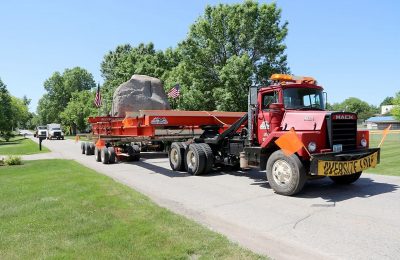
On June 4, 2020, the Billy Bell House Moving, LLC moved the massive boulder to its new home in Glidden. The company worked to raise the boulder and load onto a steel beam trailer. Wheels were incorporated to distribute the weight more evenly, thereby minimizing damage to the road surface. The truck and trailer were so large that no other traffic was allowed on the road during the move.
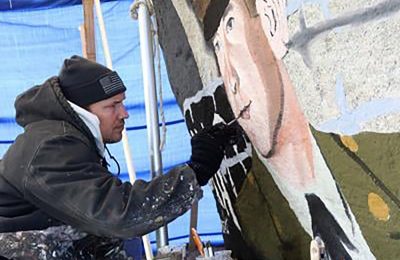
The rock was moved to Northland Park located on the north side of Highway 30 at Sherwood Avenue in Glidden, a total of 23 miles. The boulder became the Glidden Liberty Rock. Ray “Bubba” Sorensen who has painted all the Freedom Rocks in the state has been contracted to paint this rock using a patriotic theme.
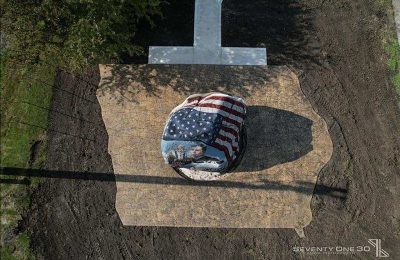
The moving costs were $17,000 out of the total project cost of $83,589.05, which $70,689 was raised through grants and donations. The city has obtained some grants and many individuals have donated to the project. Decorative concrete pavement shaped as the State of Iowa, sidewalk connecting the park trail, benches, landscaping, flag poles, and lighting will be added to complete the Liberty Rock attraction.
Source: The Freedom Rock Facebook Page
November 4, 2021
As a mural artist, who has spent the last decade creating Freedom Rocks in Iowa, I get asked from time to time if I’d paint a rock, even if it wasn’t part of the official Freedom Rock Tour. My answer is usually, yes. Even though too many people rudely ask, “What is your REAL job?”, like most artists and other contractors, I enjoy what I do and am blessed to provide for my family by creating artwork… even though like most jobs, it takes a lot outta me.
This rock in Glidden, Iowa, that I believe is being called the Glidden Liberty Rock, is one of those projects. The mayor knew of a large (I nicknamed it “The Mountain”) rock north of Bayard, IA and had a vision of dragging it up to Glidden and having me paint it. That vision has made it part way through, as they have some landscaping plans to further enhance this new addition to their town.
Side note: Had a great time catching up with fellow Representative Brian Best, the Brincks and visiting with the Jepson’s, who’ve seen all 99 Iowa Freedom Rocks!
Now for a quick “walk around” this beast. After reading about how Glidden had bookended both World Wars, I knew I wanted to illustrate that incredible tie to history. With (perhaps) the first American serviceman killed in action in World War I, Merle Hay, to the bomb dropped on the Japanese city of Hiroshima by Paul Tibbets (his mother was Enola Gay Haggard of Glidden, and the namesake of his Boeing B-29 Superfortress bomber that dropped the bomb) persuading their surrender and end to World War II. Amazing that this little town in Iowa has claims to that history!
Ralph Neppel’s joined the Army from Glidden, Iowa, in March 1943. By December 14, 1944, he was serving as a sergeant in Company M, 329th Infantry Regiment, 83rd Infantry Division. During a German counterattack on that day, at Birgel, Germany, one of his legs was severed by and the other nearly severed, when a high velocity tank round struck his position. Being thrown 10 yards from his machinegun, he crawled back using his hands and elbows to set up his gun and eliminate the remaining German force. The tank commander crawled out and shot Ralph in the head, but it ricocheted off his helmet. Neppel survived his wounds, although his remaining leg was badly damaged and had to be amputated. On August 23, 1945, he was awarded the Medal of Honor by President Harry S. Truman in a White House ceremony. During his recovery and rehabilitation at McCloskey General Hospital in Temple, Texas, Neppel was fitted with prostheses and was promoted from sergeant to technical sergeant. He married his then fiancée Jean Moore. Neppel returned to work at his 240-acre Iowa farm and earned a bachelor’s degree and attended graduate school. He worked for the Veterans Administration for 22 years. He served for eight years on the Iowa Governor’s Committee for the Employment of the Handicapped, and in 1969 he was a finalist for the President’s award for Handicapped Person of the Year. Neppel died in 1987 at age 63 and was buried in Holy Family Cemetery, Lidderdale, Iowa.
The story of Donald Lee Sparks is a long and sad one. He was born on November 7, 1946 to Calvin and Arloha Sparks in Carroll, Iowa. The family farmed southwest of Glidden, producing cattle, hogs, corn, soybeans, and alfalfa. Don was one of four children. Ronald was his older brother, Russel his younger brother, and his sister Esta was the youngest of the four.
After graduation from Glidden-Ralston High School in 1964, Don attended Iowa State, where he received a degree in Farm Operations Management in 1968. His college roommate, John Ealy recalled, “Don did excellent in college, and was quick to understand and put together and make sense of concepts.” Don attended Iowa State on a draft deferment from his Army draft notice. Don originally wanted to serve in the Air Force, but instead the Army called, and he accepted.
He was assigned to 1st Platoon, Company C, 3rd Battalion, 21st Infantry, 196th Infantry Brigade, American Division, then serving in Vietnam. Don broke his ankle during Basic Training but was sent to Vietnam anyway. On June 17, 1969, Cpl. Larry A. Graham and PFC Donald L. Sparks, whose ankle still hadn’t healed completely, were serving as point men for their company when it was ambushed by an enemy force near Chu Lai, in the Tien Phuoc District, Quang Tin Province, South Vietnam. Witnesses indicated that both men were hit and fell to the ground. As the remaining members of the patrol withdrew, they observed North Vietnamese Army personnel stripping PFC Sparks of his clothing and weapon. No one was able to reach the area where they lay for almost twelve hours because of heavy enemy fire, however, and several members of the platoon believed both men to be dead.
Air strikes were requested and napalm, and 500- and 1,000-pound bombs were dropped on the enemy position. Later the same day, another attempt was made to reach the bodies, but again it was thwarted by the enemy. On the morning of June 18, a recovery element was able to reach the site, but was unable to locate the remains of PFC Sparks. The remainder of the day was spent in digging in the vicinity of a bomb crater where witnesses had last seen Sparks. The remains of Cpl. Graham were recovered during this search. It was believed that PFC Sparks’ body had been destroyed by the air strikes, but with no positive evidence of death, Sparks was initially listed as Missing in Action.
On May 17, 1970, a Viet Cong soldier was killed in fighting near Chu Lai. On his body, American soldiers from the 19th Infantry Division found two letters from Donald Sparks dated April 11, 1970, ten months after Sparks had been presumed dead. One of the letters was addressed to his parents and included information that only Sparks could have known, like his bank account number in Glidden and questions about his family and farming. Sparks also said he was wounded in the foot and head. A report from the 8th Military Personnel Group crime lab conclusively proved that the letters were written by PFC Sparks. Six months later, Sparks’ official status was changed to Prisoner Of War and his rank was upgraded to sergeant. On September 19, 1973, a Vietnamese Army returnee stated that a U.S. POW entered a POW camp in February 1970 using a stick for support as his feet and legs were bruised. Allegedly, the POW later contracted beriberi and is reported to have died in June 1971. This report was correlated to Donald Sparks. Donald Sparks was apparently never held with any returning American POWs. Studies of the Vietnamese prison system indicate that those POWs who returned had all been held together, moving from camp to camp within the same system, but that other systems probably existed.
On 5 November 1979, since nothing had been heard of him for nine years, a military tribunal once again ruled that Sparks was dead, only this time he was listed as having died in captivity; however, government documents report a list of possible sightings and an investigation into Sparks’ disappearance running well into the 1990s. “Previous investigations indicate that PFC Donald Sparks was alive in January/February 1970, when he was taken from the field hospital where his wounds were treated,” Sparks’ Army file says. “… What happened to Sparks after he left the field hospital remains unknown.” Besides the letters, the most compelling evidence that Sparks was alive for years after the fire fight that day comes from a nurse in a Vietnamese hospital who says that Sparks’ blood was used for transfusions for North Vietnamese soldiers. Her report is corroborated by a North Vietnamese officer who said Sparks could speak Vietnamese.
The Sparks family has been in contact with the US Department of Defense since Donald’s disappearance and has learned a few facts regarding his time as a POW, including a story of how Don escaped a camp with white sheets to make a “HELP” sign, but was recaptured a few days later. They’ve also been told that Don would “get to a window” every time a plane went by, and that officers from the hospital where he was held related that he made them nervous, so they decided to move him from that hospital to a POW camp with other Americans. And this is where the trail of Sparks’ fate disappears. In fact, in 1973, American POW Maj. Harold Kushner and two other released American POWs stated that in the spring of 1970, while en route to a new detention camp in the same province in which Sparks was lost, their Vietnamese interpreter and guard said that a U.S. POW by the name of Don was scheduled to join his POW group but had been moving more slowly because of foot wounds. This occurred in the spring of 1970, but “the soldier named Don” never joined the other Americans.
Joseph Glidden, the town’s namesake, was an American businessman and farmer. He was the inventor of the modern barbed wire. In 1898, he donated land for the Northern Illinois State Normal School in DeKalb, Illinois, which was renamed as Northern Illinois University in 1957. Glidden worked on ways to make a useful barbed wire to fence cattle in 1873. He made his best design of barbed wire by using a coffee mill to create the barbs. Glidden placed the barbs along a wire and then twisted another wire around it to keep the barbs in place, in a design that he called “The Winner”, being his best design. He received the patent for that barbed wire design on November 24, 1874, when he was 61 years old. He and local hardware dealer Isaac L. Ellwood began manufacturing and selling the barbed wire with his patent, as the Barb Fence Company in DeKalb, Illinois. In 1876, Glidden exited the manufacturing aspect, though retaining royalties, by selling his half of the manufacturing business to Washburn and Moen, whom Glidden and Ellwood had been purchasing steel wire. It was estimated that Glidden earned $1,000,000 in royalties until his patent expired in 1892. Companies manufacturing the barbed wire under his license ranged from New York state to Kansas by 1884. By the time of his death in 1906, he was one of the richest men in America. Glidden passed away at age 93 in 1906. The “barbed wire salesman” in Back to the Future Part III is probably based on Glidden.
Old Glory rolls over the top and down one of the sides like so many of my murals and rocks, in honor of all those who’ve served our country.
Hope this makes a neat destination for y’all in a historic little town in Iowa.
Ray “Bubba” Sorensen II, Greenfield, Iowa
Design Engineer – Bolton and Menk
Concrete shape of Iowa and Walking Path Connection – Kirsch Custom Builders
Benches donated by – In Loving Memory of Tom Brincks & In Loving Memory of Bud & Lois Rohrbeck
Plantings and Landscaping donated by- Rhonda Schroeder